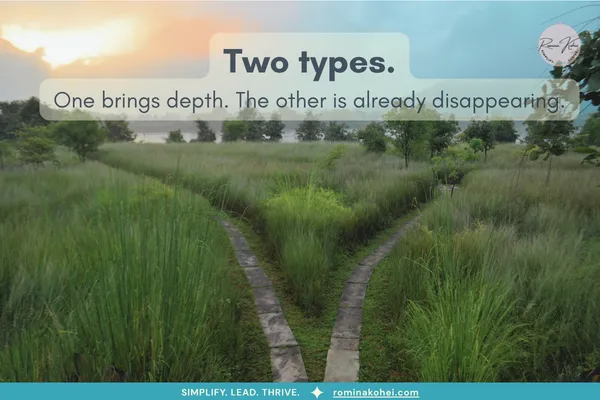
Two types of service companies are emerging in 2026
One brings depth. The other is already disappearing.
There's a split happening in production-services businesses right now, and most owners haven't named it yet.
It's not about size. It's not about how much technology you've adopted. It's not even about revenue. The divide is simpler than that, and it's getting sharper by the quarter.
Two types of service companies are emerging. One brings depth: real expertise, strong processes, people who know why the work matters, and systems that hold up when the founder isn't in the room. The other type's main asset is customer contacts. The team coordinates. The real work happens somewhere else. And the market is quietly squeezing the second group out of existence.
I've been watching this unfold in the localization industry because the data there is unusually clear. The latest Nimdzi 100 report shows that the top 10 language service providers actually lost market share last year, dropping from 10.5% to 9.6%. The top 100 dropped from 20.5% to 19.7%. The giants aren't eating the middle. The industry is more fragmented than it's been in years.
But underneath the fragmentation numbers, a different pattern is forming. Enterprise buyers are routing wider portfolios through fewer production partners. Individual client relationships are deepening even as the overall market disperses. Buyers don't want more vendors. They want fewer, deeper ones. The service company the client never wants to replace is the one that survives.
This isn't just a localization story. Every production-services vertical is experiencing some version of the same split: design studios, development agencies, content shops, consulting practices. The specifics differ. The structural pattern doesn't.
What separates the two types
The first type builds value that exists independent of any single person. The expertise is documented. The quality standards are teachable. The client relationships are held by the team, not stored exclusively in the founder's head. When someone leaves, the knowledge stays. When the team grows, the processes grow with it.
The second type looks functional from the outside but runs on a thin layer of coordination. Project managers act as a firewall between the client and whoever actually does the work. The company's value is its address book. The operational depth is shallow enough that any serious disruption, a key person leaving, a client audit, a technology shift, exposes the gap.
Both types can be the same size. Both can have the same revenue. Both can even serve the same clients. The difference only becomes visible under pressure. And in 2026, the pressure is arriving from multiple directions at once.
Buyers are demanding more output for flat or shrinking budgets. They're not asking for cheaper work. They're asking for less friction in the partnership. Their scorecards now weight workflow integration, accountability, and how easy a company is to work with, not just per-unit pricing. The companies that can meet that ask are the ones with operational substance underneath the relationship. The ones that can't are the ones where the relationship was the entire product.
Why good companies end up in the wrong group
Here's the thing that makes this split painful. Most companies in the second group didn't start there on purpose. They started as depth-first businesses. The founder had real expertise. The early team was excellent. The client relationships were genuine.
What happened was growth without structural change. They hired more people but didn't change how decisions got made. They added clients but didn't build the operational layer to service them without the founder's constant involvement. They scaled the coordination but not the capability.
I've watched this pattern play out in companies with well over a hundred people. It's not a small-company problem. It's a "we grew without changing the core" problem. And by the time the company recognizes it needs a real operations layer, the culture is often so ingrained in the old way that the same people can't make the shift.
One of the hardest lines I've had to say to a client: doing the same thing over and over does not equal being effective. The company that grew by adding more task pushers instead of building real operational coordination doesn't get more efficient with scale. It gets more fragile.
The test is simpler than you think
You don't need an audit to know which type you're building. You need two honest answers.
First: if your three biggest client contacts changed roles tomorrow, who at your company could rebuild those relationships without you? If the answer is "nobody" or "maybe, but it would take months," your company's value is still living in individual people's heads, not in the business.
Second: if a buyer asked you to double your output in the same timeframe without adding headcount, could your current systems handle it? Not by working harder. By working differently. If the answer is "we'd figure it out," that's not a system. That's heroics. And heroics don't scale.
The companies passing both of those tests aren't necessarily bigger. They're not necessarily more profitable today. But they're the ones buyers want to keep. They're the ones team members want to join. And they're the ones that will still be standing when the next round of market pressure arrives.
What the data is actually saying
The fragmentation in the localization industry data tells us something broader. The market isn't consolidating the way everyone expected. The big players aren't swallowing the middle. Instead, the middle is splitting. The depth-first companies are holding position and even gaining ground because buyers want fewer, better partners. The coordination-only companies are losing position because their value proposition, being the contact point, is exactly the layer that technology and procurement processes are compressing.
This split is structural, not cyclical. It won't reverse when the economy shifts. The buyer expectation has moved permanently. They want accountability, not just availability. They want a company that can think alongside them, not just execute what they're told.
For the founder running a service company in 2026, the question isn't "how do I grow?" It's "which type am I building?" Because the answer to that question determines whether more growth makes the company stronger or more fragile.
What I'd want you to sit with
Which type are you building? And would the answer change if your biggest client asked you tomorrow?
That second question matters more than the first. Because most founders know, in the quiet moments, which type they are. The harder part is knowing whether the next twelve months will leave them in the same group or push them to the other side.
I'd love to hear which question landed. Tell me in the comments, or send me a message. I read every one.